
| commit | 3480ba2c6df02bb907d3a975d354efa8697c4e71 | [log] [tgz] |
|---|---|---|
| author | Zhaoqi Zhu <zhaoqizhu96@gmail.com> | Fri Jul 16 14:30:24 2021 -0700 |
| committer | GitHub <noreply@github.com> | Fri Jul 16 14:30:24 2021 -0700 |
| tree | d872333f8c95a2b7481a280ca576af6a1c19318c | |
| parent | 8fd17cef2ee854239c6e66f2dd3b9467aa222f79 [diff] |
[ONNX] Foward port new mx2onnx into master (#20355)

* initial: forward port mx2onnx and remove onnx2mx

* fix sanity

* add onnx operator unit tests

* add test file

* add model test

* fix license & doc

* fix

* marching toward 2.0

* fix typo

* add more ops

* more ops

* more ops

* more ops

* fix softmax and sanity

* more ops

* more ops

* more ops

* naming

* more ops

* more ops

* more ops and bug fix

* more ops and skip unvisited tests

* fix sanity

* fix for onnx18

* more ops

* fix

* fix onnx 18

* more ops

* skip model test

* update read me

* more ops

* more ops

* more ops

* more ops

* more ops

* Update test_models.py
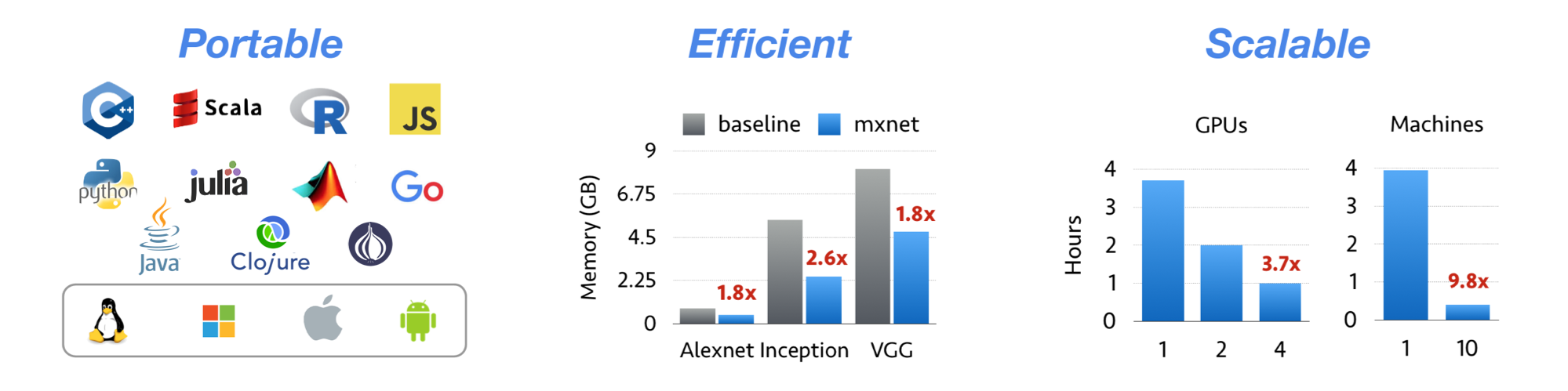








Apache MXNet is a deep learning framework designed for both efficiency and flexibility. It allows you to mix symbolic and imperative programming to maximize efficiency and productivity. At its core, MXNet contains a dynamic dependency scheduler that automatically parallelizes both symbolic and imperative operations on the fly. A graph optimization layer on top of that makes symbolic execution fast and memory efficient. MXNet is portable and lightweight, scalable to many GPUs and machines.
MXNet is more than a deep learning project. It is a community on a mission of democratizing AI. It is a collection of blue prints and guidelines for building deep learning systems, and interesting insights of DL systems for hackers.
Licensed under an Apache-2.0 license.
| Branch | Build Status |
|---|---|
| master |             |
| v1.x |            |
| Channel | Purpose |
|---|---|
| Follow MXNet Development on Github | See what's going on in the MXNet project. |
| MXNet Confluence Wiki for Developers | MXNet developer wiki for information related to project development, maintained by contributors and developers. To request write access, send an email to send request to the dev list . |
| dev@mxnet.apache.org mailing list | The “dev list”. Discussions about the development of MXNet. To subscribe, send an email to dev-subscribe@mxnet.apache.org . |
| discuss.mxnet.io | Asking & answering MXNet usage questions. |
| Apache Slack #mxnet Channel | Connect with MXNet and other Apache developers. To join the MXNet slack channel send request to the dev list . |
| Follow MXNet on Social Media | Get updates about new features and events. |
Keep connected with the latest MXNet news and updates.
MXNet emerged from a collaboration by the authors of cxxnet, minerva, and purine2. The project reflects what we have learned from the past projects. MXNet combines aspects of each of these projects to achieve flexibility, speed, and memory efficiency.
Tianqi Chen, Mu Li, Yutian Li, Min Lin, Naiyan Wang, Minjie Wang, Tianjun Xiao, Bing Xu, Chiyuan Zhang, and Zheng Zhang. MXNet: A Flexible and Efficient Machine Learning Library for Heterogeneous Distributed Systems. In Neural Information Processing Systems, Workshop on Machine Learning Systems, 2015
