

| # Dependency Engine for Deep Learning | |
| We always want deep learning libraries | |
| to run faster and scale to larger datasets. | |
| One natural approach is to see if we can benefit | |
| from throwing more hardware at the problem, | |
| as by using multiple GPUs simultaneously. | |
| Library designers then ask: | |
| How can we *parallelize* computation across devices? | |
| And, more importantly, how can we *synchronize* computation | |
| when we introduce multi-threading? | |
| A runtime dependency engine is a generic solution to these problems. | |
| In this document, we examine approaches for using | |
| runtime dependency scheduling to accelerate deep learning. | |
| We aim to explain how runtime dependency scheduling | |
| can both speed up and simplify multi-device deep learning. | |
| We also explore potential designs for a generic dependency engine | |
| that could be both library- and operation-independent. | |
| Most of the discussion of on this page draws inspiration | |
| from the MXNet dependency engine. | |
| The dependency tracking algorithm we discuss | |
| was primarily developed by [Yutian Li](https://github.com/hotpxl) | |
| and [Mingjie Wang](https://github.com/jermainewang). | |
| ## Dependency Scheduling | |
| Although most users want to take advantage of parallel computation, | |
| most of us are more familiar with serial programs. | |
| So one natural question is: how can we write serial programs | |
| and build a library to automatically parallelize our programs | |
| in an asynchronous way? | |
| For example, in the following code, we can run `B = A + 1` | |
| and `C = A + 2` in any order, or in parallel: | |
| ```python | |
| A = 2 | |
| B = A + 1 | |
| C = A + 2 | |
| D = B * C | |
| ``` | |
| However, it's quite hard to code the sequence manually | |
| because the last operation, `D = B * C`, needs to wait | |
| for both of the preceding operations to complete before it starts. | |
| The following dependency graph/data flow graph illustrates this. | |
| 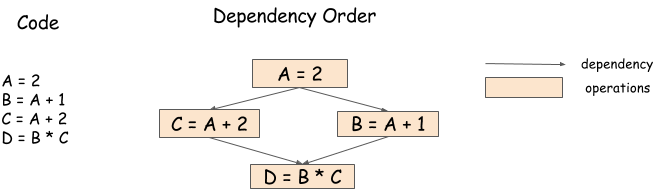 | |
| A dependency engine is a library that takes a sequence of operations | |
| and schedules them according to the dependency pattern, potentially in parallel. | |
| So in this example, a dependency library | |
| could run ```B = A + 1``` and ```C = A + 2``` in parallel, | |
| and run ```D = B * C``` after those operations complete. | |
| ## Problems in Dependency Scheduling | |
| A dependency engine relieves the burden of writing concurrent programs. | |
| However, as operations become parallelized, | |
| new dependency tracking problems arise. | |
| In this section, we discuss those problems. | |
| ### Data Flow Dependency | |
| Data flow dependency describes how the outcome of one computation | |
| can be used in other computations. | |
| Every dependency engine has to solve the data flow dependency problem. | |
|  | |
| Because we discussed this issue in the preceding section, | |
| we include the same figure here. Libraries that have | |
| data flow tracking engines include Minerva and Purine2. | |
| ### Memory Recycling | |
| When should we recycle the memory that we allocated to the arrays? | |
| In serial processing, this is easy to determine. | |
| We simply recycle the memory after the variable goes out of scope. | |
| However, as the following figure shows, this is a bit harder in parallel processing. | |
| 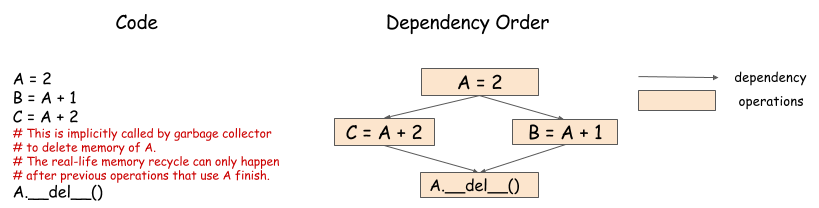 | |
| In this example, because both computations need to use values from A, | |
| we can't recycle the memory until both complete. | |
| The engine must schedule the memory recycling operations according to the dependencies, | |
| and ensure that they are executed after both ```B = A + 1``` and ```C = A + 2``` complete. | |
| ### Random Number Generation | |
| Random number generators, which are commonly used in machine learning, | |
| pose interesting challenges for dependency engines. | |
| Consider the following example: | |
| 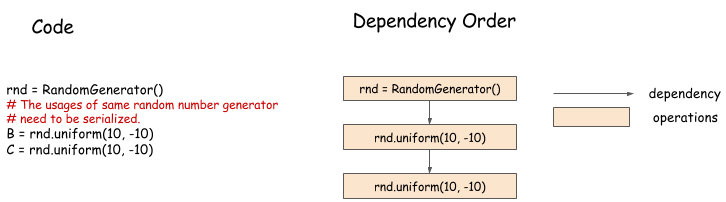 | |
| In this example, we are generating random numbers in a sequence. | |
| Although it seems that the two random number generations can be parallelized, | |
| this is usually not the case. A pseudo-random number generator (PRNG) | |
| is not thread-safe because it might cause some internal state | |
| to mutate when generating a new number. | |
| Even if the PRNG is thread-safe, | |
| it is preferable to serialize number generation, | |
| so we can get reproducible random numbers. | |
| ## Case Study: A Dependency Engine for a Multi-GPU Neural Network | |
| In the last section, we discussed the problems | |
| we might face in designing a dependency engine. | |
| Before thinking about how to design a generic engine to solve those problems, | |
| let's consider how a dependency engine can help in multi-GPU training of a neural network. | |
| The following pseudocode Python program illustrates | |
| training one batch on a two-layer neural network. | |
| ```python | |
| # Example of one iteration Two GPU neural Net | |
| data = next_batch() | |
| data[gpu0].copyfrom(data[0:50]) | |
| data[gpu1].copyfrom(data[50:100]) | |
| # forward, backprop on GPU 0 | |
| fc1[gpu0] = FullcForward(data[gpu0], fc1_weight[gpu0]) | |
| fc2[gpu0] = FullcForward(fc1[gpu0], fc2_weight[gpu0]) | |
| fc2_ograd[gpu0] = LossGrad(fc2[gpu0], label[0:50]) | |
| fc1_ograd[gpu0], fc2_wgrad[gpu0] = | |
| FullcBackward(fc2_ograd[gpu0] , fc2_weight[gpu0]) | |
| _, fc1_wgrad[gpu0] = FullcBackward(fc1_ograd[gpu0] , fc1_weight[gpu0]) | |
| # forward, backprop on GPU 1 | |
| fc1[gpu1] = FullcForward(data[gpu1], fc1_weight[gpu1]) | |
| fc2[gpu1] = FullcForward(fc1[gpu1], fc2_weight[gpu1]) | |
| fc2_ograd[gpu1] = LossGrad(fc2[gpu1], label[50:100]) | |
| fc1_ograd[gpu1], fc2_wgrad[gpu1] = | |
| FullcBackward(fc2_ograd[gpu1] , fc2_weight[gpu1]) | |
| _, fc1_wgrad[gpu1] = FullcBackward(fc1_ograd[gpu1] , fc1_weight[gpu1]) | |
| # aggregate gradient and update | |
| fc1_wgrad[cpu] = fc1_wgrad[gpu0] + fc1_wgrad[gpu1] | |
| fc2_wgrad[cpu] = fc2_wgrad[gpu0] + fc2_wgrad[gpu1] | |
| fc1_weight[cpu] -= lr * fc1_wgrad[cpu] | |
| fc2_weight[cpu] -= lr * fc2_wgrad[cpu] | |
| fc1_weight[cpu].copyto(fc1_weight[gpu0] , fc1_weight[gpu1]) | |
| fc2_weight[cpu].copyto(fc2_weight[gpu0] , fc2_weight[gpu1]) | |
| ``` | |
| In this program, the data 0 to 50 is copied to GPU 0, | |
| and the data 50 to 100 is copied to GPU 1. | |
| The calculated gradients are aggregated in the CPU, | |
| which then performs a simple SGD update, | |
| and copies the updated weight back to each GPU. | |
| This is a common way to write a parallel program in a serial manner. | |
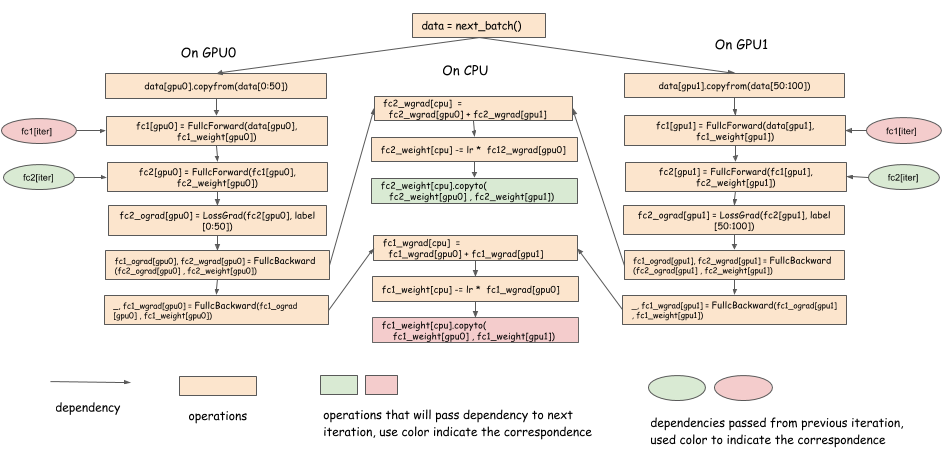
| The following dependency graph shows how it can be parallelized: | |
|  | |
| ***Notes:*** | |
| - The gradient can be copied to the CPU as soon as we get the gradient of a layer. | |
| - The weight can be copied back soon as the weight is updated. | |
| - In the forward pass, we have a dependency on ```fc1_weight[cpu].copyto(fc1_weight[gpu0] , fc1_weight[gpu1])``` | |
| from the previous iteration. | |
| - There is a delay in computation between the last backward pass to layer k and the next forward call to layer k. We can synchronize the weight of layer k *in parallel* with other computation during this delay. | |
| This approach to optimization is used by multi-GPU deep learning libraries, such as CXXNet. | |
| The point is to overlap weight synchronization (communication) with computation. | |
| However, it's not easy to do that, because the copy operation needs to be triggered | |
| as soon as the backward pass of the layer completes, | |
| which then triggers the reduction, updates, etc. | |
| A dependency engine can schedule these operations and perform multi-threading | |
| and dependency tracking. | |
| ## Designing a Generic Dependency Engine | |
| We hope that you're convinced that a dependency engine is useful | |
| for scaling deep learning programs to multiple devices. | |
| Now let's discuss how we can design and implement | |
| a generic interface for a dependency engine. | |
| This solution isn't the only possible design for a dependency engine. | |
| It's an example that we think is useful in most cases. | |
| Our goal is to create a dependency engine that is *generic* and *lightweight*. | |
| Ideally, we'd like the engine that easily plugs into existing deep learning code, | |
| and that can scale up to multiple machines with minor modifications. | |
| To do that, we need to focus only on dependency tracking, | |
| not on assumptions about what users can or can't do. | |
| Here's a summary of goals for the engine: | |
| - The engine should not be aware of what operations it performs, so that users can perform any operations they define. | |
| - It should not be restricted in what type of objects it can schedule. | |
| - We should be able to schedule dependencies on GPU and CPU memory. | |
| - We should be able to track dependencies on the random number generator, etc. | |
| - The engine should not allocate resources. It should only track dependencies. Users can allocate their own memory, PRNG, etc. | |
| The following Python snippet provides an engine interface that might help us reach our goal. Note that a real implementation will be closer to the metal, typically in C++. | |
| ```python | |
| class DepEngine(object): | |
| def new_variable(): | |
| """Return a new variable tag | |
| Returns | |
| ------- | |
| vtag : Variable Tag | |
| The token of the engine to represent dependencies. | |
| """ | |
| pass | |
| def push(exec_func, read_vars, mutate_vars): | |
| """Push the operation to the engine. | |
| Parameters | |
| ---------- | |
| exec_func : callable | |
| The real operation to be performed. | |
| read_vars : list of Variable Tags | |
| The list of variables this operation will read from. | |
| mutate_vars : list of Variable Tags | |
| The list of variables this operation will mutate. | |
| """ | |
| pass | |
| ``` | |
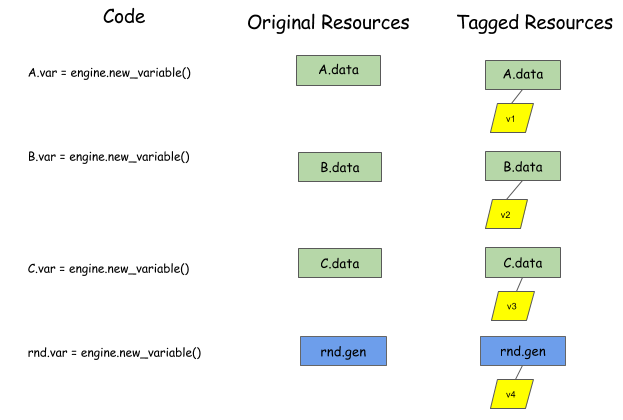
| Because we can't make assumptions about what objects we are scheduling, we ask the user to allocate a | |
| _virtual tag_ that is associated with each object to represent what we need to schedule. | |
| So, at the beginning, the user can allocate the variable tag, | |
| and attach it to each of the objects that we want to schedule. | |
|  | |
| The user then calls `push` to tell the engine about the function to execute. | |
| The user also needs to specify the dependencies of the operation, | |
| using `read_vars` and `write_vars`: | |
| - `read_vars` are variable tags for objects that the operation will _read from_, without changing their internal state. | |
| - `mutate_vars` are variable tags for objects whose internal states the operation will mutate. | |
| 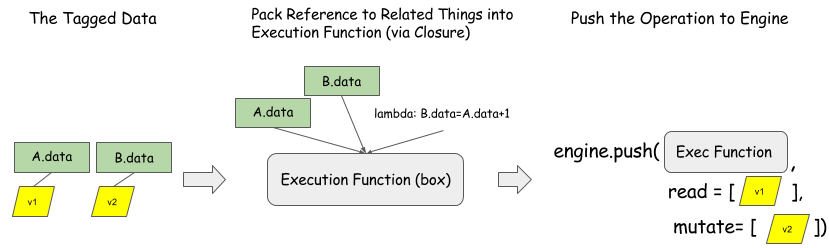 | |
| The preceding figure shows how to push operation `B = A + 1` to the dependency engine. `B.data` and | |
| `A.data` are the allocated space. Note that the engine is *only aware of variable tags*. | |
| Any execution function can be processed. | |
| This interface is generic for the operations and resources we want to schedule. | |
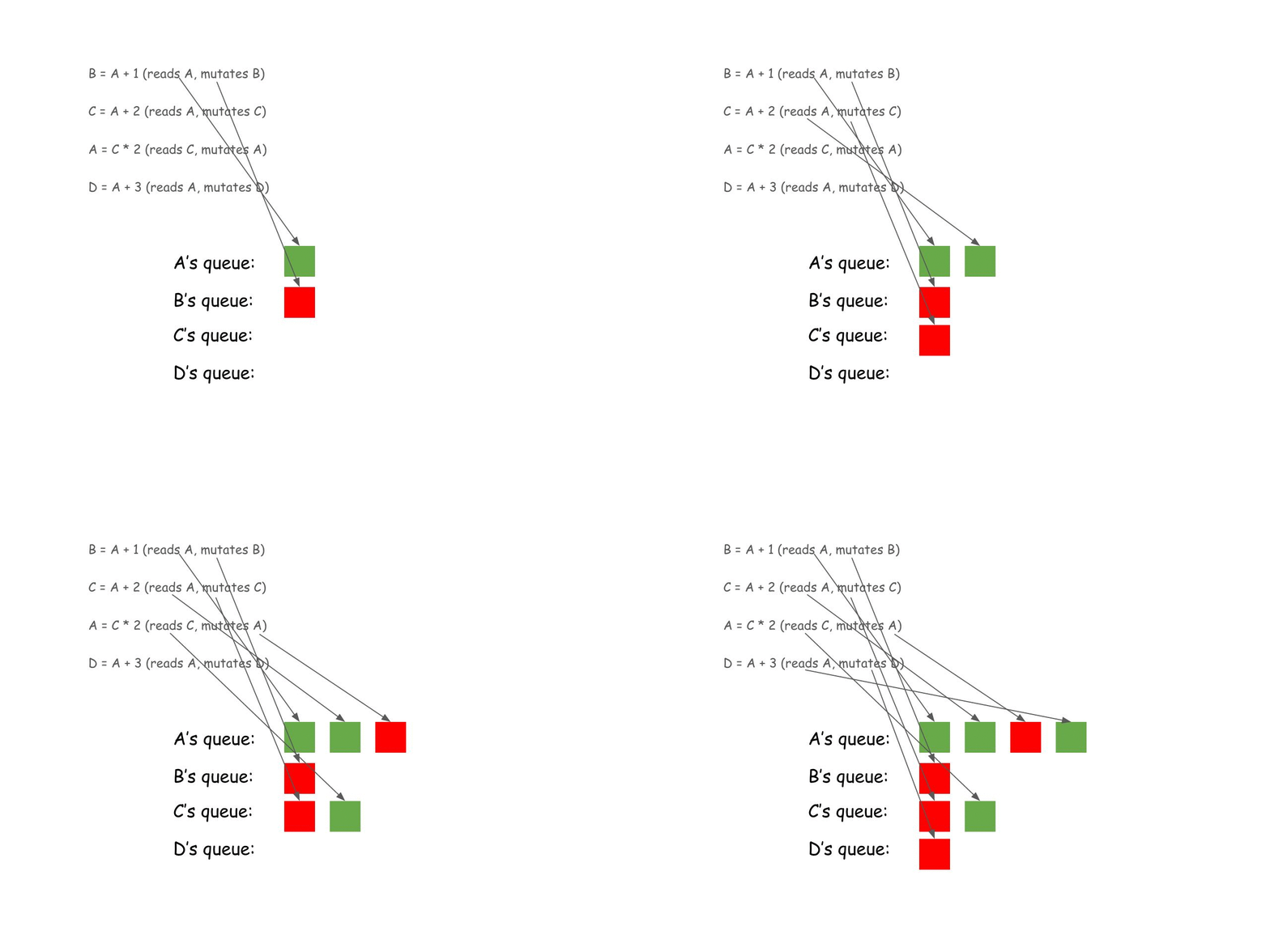
| For fun, let's look at how the engine internals work with the tags by considering the following code snippet: | |
| ``` | |
| B = A + 1 | |
| C = A + 2 | |
| A = C * 2 | |
| D = A + 3 | |
| ``` | |
| The first line reads variable `A` and mutates variable `B`. The second line reads variable `A` and mutates variable `C`. And so on. | |
| The engine maintains a queue for each variable, as the following animation shows for each of the four lines. Green blocks represents a read action, while red blocks represent mutations. | |
|  | |
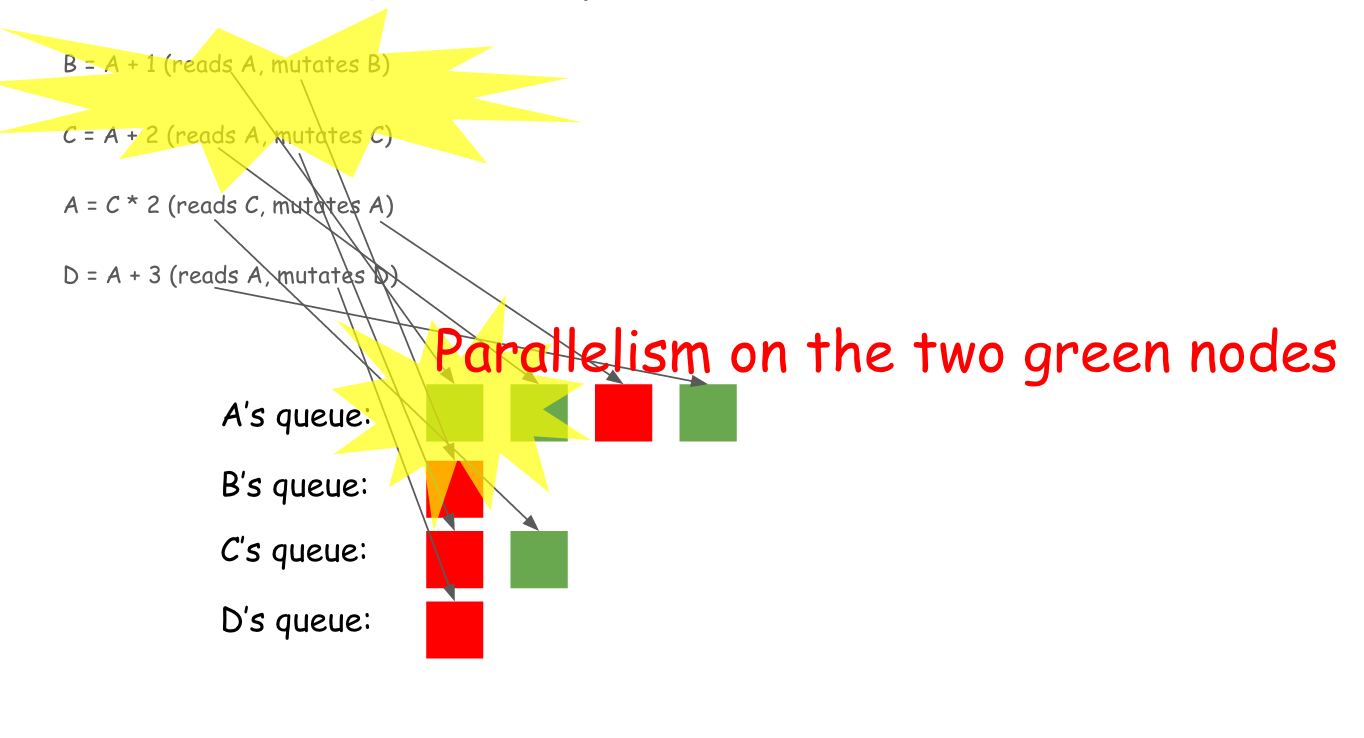
| Upon building this queue, the engine sees that the first two green blocks at the beginning of `A`'s queue could actually be run in parallel because they are both read actions and won't conflict with each other. The following graph illustrates this point. | |
|  | |
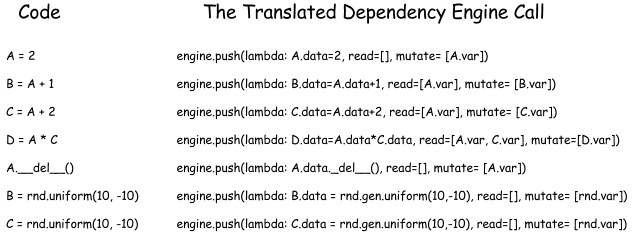
| One cool thing about all this scheduling is that it's not confined to numerical calculations. | |
| Because everything that is scheduled is only a tag, the engine could schedule everything! | |
| The following figure gives a complete push sequence of the programs we mentioned in previous sections. | |
|  | |
| ### Porting Existing Code to the Dependency Engine | |
| Because the generic interface doesn't control things like memory allocation and which operation to execute, | |
| most existing code can be scheduled by the dependency engine in two steps: | |
| 1. Allocate the variable tags associated with resources like memory blob, PRNGS. | |
| - Call `push` with the execution function as the original code to execute, and put the variable tags of | |
| corresponding resources correctly in `read_vars` and `mutate_vars`. | |
| ## Implementing the Generic Dependency Engine | |
| We have described the generic engine interface and | |
| how it can be used to schedule various operations. | |
| In this section, we provide a high-level discussion | |
| of how to implement such an engine. | |
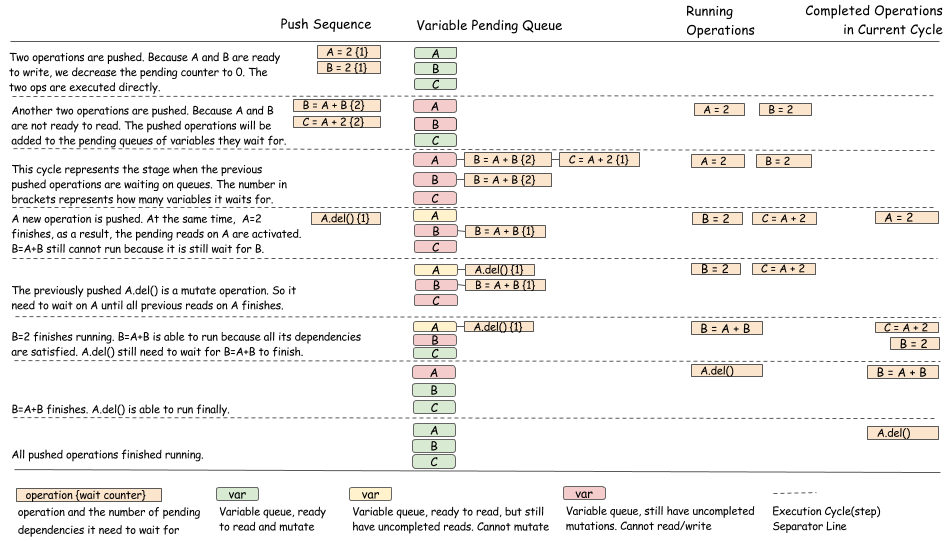
| The general idea is as follows: | |
| - Use a queue to track all of the pending dependencies on each variable tag. | |
| - Use a counter on each operation to track how many dependencies are yet to be fulfilled. | |
| - When operations are completed, update the state of the queue and dependency counters to schedule new operations. | |
| The following figure illustrates the scheduling algorithm | |
| and might give you a better sense of what is going on in the engine. | |
|  | |
| Below, we show another example involving random number generators. | |
| 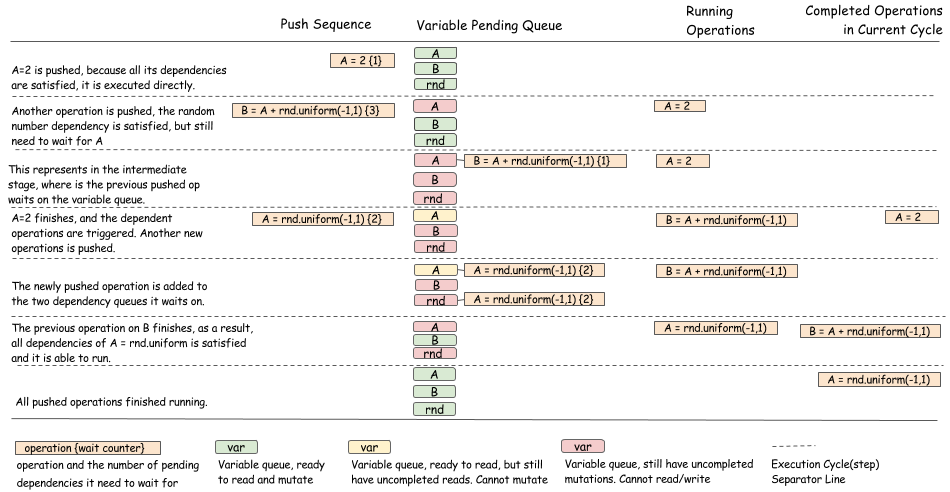 | |
| As you can see, the purpose of the algorithm is to update pending queues | |
| of operations and to make the right state transition when an operation has completed. | |
| More care should be taken to make sure the state transitions | |
| are done in a way that's safe for threads. | |
| ### Separate Dependency Tracking with Running Policy | |
| If you're reading carefully, you might have noticed | |
| that the preceding section shows only the algorithm | |
| for deciding when an operation can be executed. | |
| We didn't show how to actually run an operation. | |
| In practice, there can be many different policies. | |
| For example, we can either use a global thread-pool to run all operations, | |
| or use a specific thread to run operations on each device. | |
| This running policy is usually independent of dependency tracking, | |
| and can be separated out as either an independent module | |
| or a virtual interface of base-dependency tracking modules. | |
| Developing an elegant runtime policy that is fair | |
| to all operations and schedules is an interesting systems problem itself. | |
| ## Discussion | |
| The design that we discussed in this article | |
| isn't the only solution to the dependency tracking problem. | |
| It's just one example of how we might approach this. | |
| To be sure, some of these design choices are debatable. | |
| We'll discuss some of them in this section. | |
| ### Dynamic vs. Static | |
| The dependency engine interface discussed in this topic is somewhat dynamic | |
| in the sense that the user can push operations one by one, | |
| instead of declaring the entire dependency graph (static). | |
| Dynamic scheduling can require more overhead | |
| than static declarations, in terms of data structure. | |
| However, it also enables more flexibility, such as supporting auto parallelism | |
| for imperative programs or a mixture of imperative and symbolic programs. | |
| You can also add some level of predeclared operations | |
| to the interface to enable data structure reuse. | |
| ### Mutation vs. Immutable | |
| The generic engine interface presented in this page | |
| supports explicit scheduling for mutation. | |
| In a typical data flow engine, the data are usually immutable. | |
| Working with immutable data has a lot of benefits. | |
| For example, immutable data is generally more suitable for parallelization, | |
| and facilitates better fault tolerance in a distributed setting (by way of re-computation). | |
| However, immutability presents several challenges: | |
| - It's harder to schedule resource contention problems, as arise when dealing with random numbers and deletion. | |
| - The engine usually needs to manage resources (memory, random number) to avoid conflicts. It's harder to plug in user-allocated space, etc. | |
| - Preallocated static memory isn't available, again because the usual pattern is to write to a preallocated layer space, which is not supported if data is immutable. | |
| Allowing mutation mitigates these issues. | |
| ## Source Code of the Generic Dependency Engine | |
| [MXNet](https://github.com/dmlc/mxnet) provides an implementation | |
| of the generic dependency engine described in this page. | |
| You can find more details in [this topic](http://mxnet.io/architecture/note_engine.html). | |
| We welcome your contributions. | |
| ## Next Steps | |
| * [Squeeze the Memory Consumption of Deep Learning](http://mxnet.io/architecture/note_memory.html) | |
| * [Efficient Data Loading Module for Deep Learning](http://mxnet.io/architecture/note_data_loading.html) | |
| * [Survey of RNN Interface](http://mxnet.io/architecture/rnn_interface.html) |