

Update deconvolution-inl.h. Change the condition control statement in InferPad. Merge differences between v0.8 and v0.9. (#6019)

* Update deconvolution-inl.h. Change the condition control statement in InferPad. Merge differences between v0.8 and v0.9.

There seems to be a bug at the condition control statement in InferPad. Original version(v0.9) only use target_shape.ndim to decide the calculation of pad. But we find even the target_shape.ndim is not zero, values of target_shape can be zero. When we load v0.8 model with v0.9, this may cause error calculation of pad.

* Try to fix lint

* Update deconvolution-inl.h


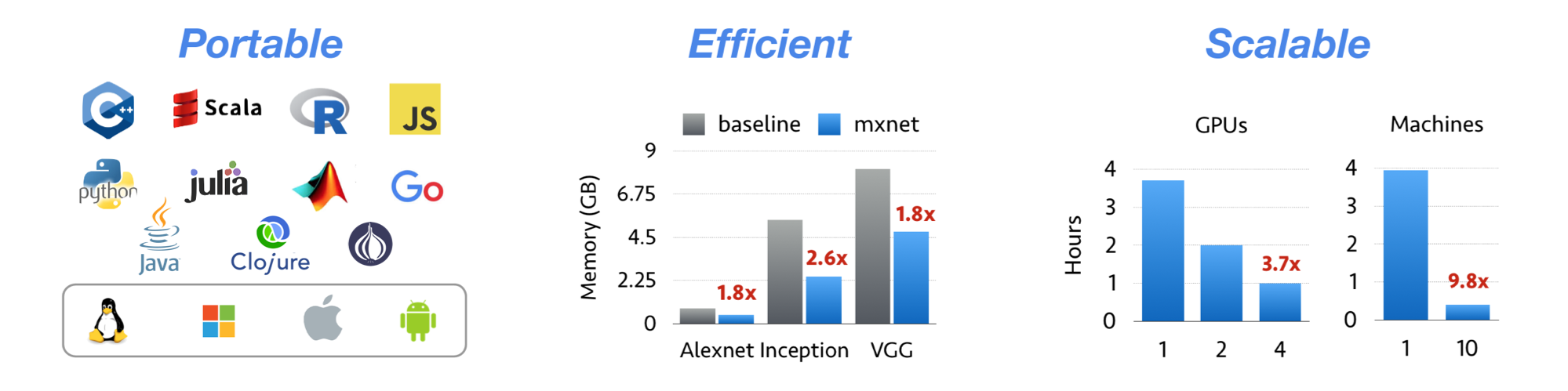
MXNet is a deep learning framework designed for both efficiency and flexibility. It allows you to mix symbolic and imperative programming to maximize efficiency and productivity. At its core, MXNet contains a dynamic dependency scheduler that automatically parallelizes both symbolic and imperative operations on the fly. A graph optimization layer on top of that makes symbolic execution fast and memory efficient. MXNet is portable and lightweight, scaling effectively to multiple GPUs and multiple machines.
MXNet is also more than a deep learning project. It is also a collection of blue prints and guidelines for building deep learning systems, and interesting insights of DL systems for hackers.

© Contributors, 2015-2017. Licensed under an Apache-2.0 license.
Tianqi Chen, Mu Li, Yutian Li, Min Lin, Naiyan Wang, Minjie Wang, Tianjun Xiao, Bing Xu, Chiyuan Zhang, and Zheng Zhang. MXNet: A Flexible and Efficient Machine Learning Library for Heterogeneous Distributed Systems. In Neural Information Processing Systems, Workshop on Machine Learning Systems, 2015
MXNet emerged from a collaboration by the authors of cxxnet, minerva, and purine2. The project reflects what we have learned from the past projects. MXNet combines aspects of each of these projects to achieve flexibility, speed, and memory efficiency.